
Wausau, WI · Garage Door Service
What Wausau's Cold Winters Do to Older Garage Doors
Wausau's housing stock dates mostly to the 1960s and 70s, and severe cold winters put real strain on garage door springs, cables, and openers in these homes.
- Repairs & new doors
- Springs & openers
- Serving 6 nearby communities
What Local Conditions Do
Most houses in this service area went up between 1955 and 2000, with the median landing around 1979. That matters because garage doors from that window were built before any insulation code applied to them - thin steel skins, no foam core, bare aluminum track. Wausau sits in a severe cold climate band, and that combination is rough on old hardware.
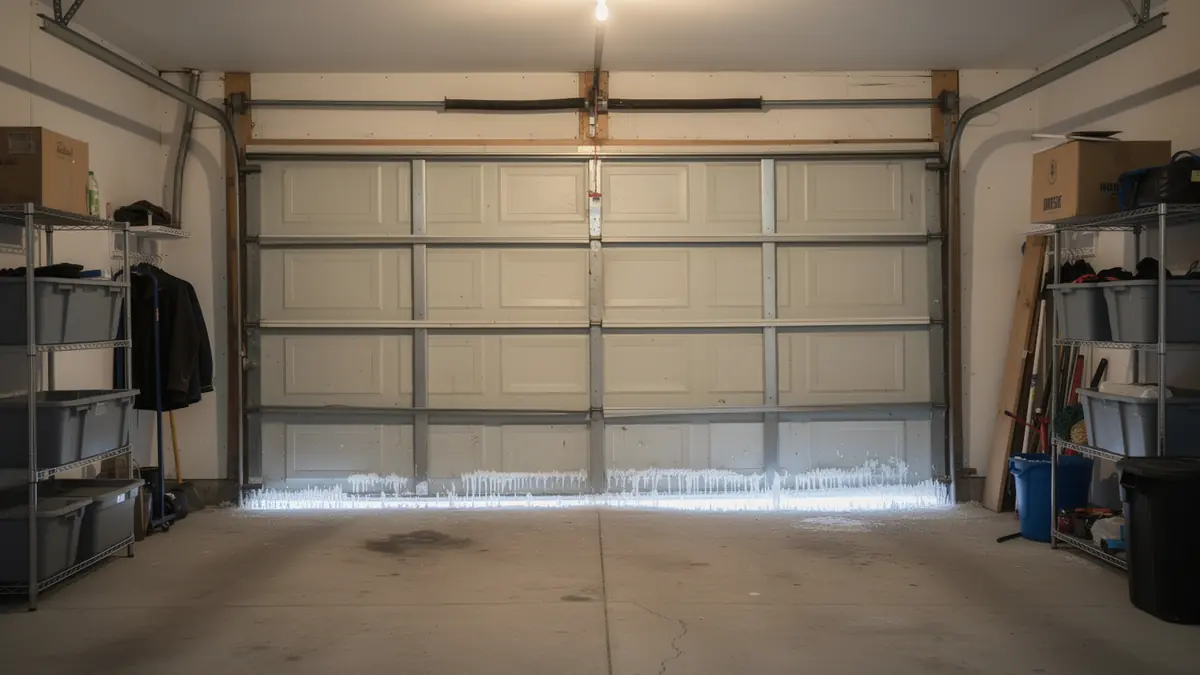
Cold doesn't just make things slow. It changes the metal itself. A torsion spring wound tight for twenty winters loses some of its temper every time the garage drops below zero, and it gives up all at once rather than gradually. Steel panels without a foam core contract enough in a hard freeze that the bottom seal pulls away from the slab, which is why owners notice drafts and ice buildup along the threshold every January rather than in July.
Lubricant is the other piece. Grease that worked fine in September turns to something close to wax at ten below, so rollers that spun free all summer start grinding, and openers pulling against that extra resistance burn out gear sets years before they should. None of this is a defect in any one door - it's what this climate does to hardware built on a 1955-2000 timeline, every single winter.
What to Look At First
Start with the spring. On a door original to its house - meaning it's never been swapped - look for rust pitting on the coils near the stationary cone. That pitting is where the metal fatigues first, and on a door this old it's usually already past a visual warning and close to failure. Don't test it by hand; a torsion spring under tension can take a finger off.
Next is the bottom seal. On steel panel doors from the 1960s-70s stock that makes up most of the neighborhoods out here, the seal track is often just a nailed-on strip, not a routed channel. If it's cracked or shrunk, cold air comes straight under the door, and that's usually the first thing an owner actually feels rather than sees.
Then the opener. If it's original to a house from this era, the gear set is almost certainly a brittle nylon that was never designed to fight the added drag of a stiff cold-weather door. A grinding or slow-closing opener in deep winter is often the gear, not the motor.
Last, check the track bolts at the top corners. Houses built on this older framing sometimes have track mounted straight to wood jambs that have shifted slightly over sixty-plus years, and a loose bolt there shows up as a door that binds only in the cold.
Leaving It Alone
Here's the honest part. If a door is original steel from the 1955-1979 era - no foam core, single layer - patching the seal or swapping the spring buys you a season, maybe two, but it doesn't fix the underlying problem: the panel itself still flexes and leaks heat. At some point replacement is the better call, not because the old door is unsafe, but because every repair on it is temporary.
We also don't stock every obsolete torsion spring size. A lot of the doors from this housing window used wind and wire combinations that manufacturers don't carry new anymore, and a special order can take longer than an owner wants to wait with a dead spring. That's a real limitation, not a sales pitch - sometimes the faster path is a new spring on new hardware rather than hunting down an exact match for a forty-year-old door.
Leaving a cracked seal alone through one more winter usually isn't dangerous. Leaving a visibly rusted spring alone is a different story - that's the part that can fail without warning and the part we'd rather see sooner than later.
The Problem
The reason this keeps coming up isn't bad luck. Across this area there are roughly 28,786 households, 17,093 of them in owner-occupied houses, and a large share of those houses - spread across neighborhoods running from Schofield and Rib Mountain out toward Rothschild and Weston - were built in that same 1955-2000 window, with most dating to the 1960s and 70s. One severe cold stretch doesn't hit one unlucky house; it hits dozens of doors built the same decade, the same way, at the same time.
At a median household income of $84,375, most owners here aren't stretched thin by a full door replacement when a forty-year-old steel panel finally gives out - which is often the more sensible move than chasing parts for hardware nobody manufactures anymore. The problem isn't any single component failing. It's a housing stock built before today's insulation standards, sitting in a climate that finds every weak point in it every winter, year after year.
Frequently asked questions
Why do garage door springs break more in winter here?
Cold makes steel lose temper over time, and Wausau's severe cold winters accelerate that on springs that are already decades old. A spring that's held fine for fifteen summers can snap on the first hard cold snap because the metal has been quietly weakening with every freeze-thaw cycle before that.
Is it worth insulating an old steel garage door instead of replacing it?
Sometimes, if the panel itself is still straight and the track is sound. But a lot of the 1955-1979 steel doors in this area were built without a foam core cavity, so retrofit insulation kits don't seal as well as they do on newer doors. We'll tell you honestly if yours is a good candidate before we sell you one.
How do I know if my opener's gear set is the problem?
If the door grinds, slows, or stalls partway only in cold weather and runs fine once the garage warms up, that points to a brittle nylon gear rather than the motor itself. Original openers from houses built in the 1960s-70s stock out here are the most common ones we see with this exact symptom.
Related garage door services in Wausau
More garage door guides
Book garage door service in Wausau
Call now or request a quote - tell us what the door is doing and where you are.