
Wausau, WI · Garage Door Service
Noises That Mean Something in a Wausau Garage
A Wausau homeowner's guide to decoding garage door noise, tied to the area's 1960s-70s housing stock and severe cold winters that strain original hardware.
- Repairs & new doors
- Springs & openers
- Serving 6 nearby communities
What Local Conditions Do
Most houses on this side of the state, including the neighborhoods around Rib Mountain and Schofield, went up between 1955 and 2000, with the bulk of that stock dating to the 1960s and 70s. That matters for noise because a door built on original hardware from that era wasn't engineered for 50+ years of Wisconsin winters. Steel fatigues, lubrication dries out, and the galvanized coating on older springs and cables thins from decades of freeze-thaw cycling.
Wausau sits in a severe cold climate band, and that cold does specific things to a garage door system. Steel tracks contract in sub-zero temperatures, which opens up gaps at the rollers that weren't there in July. Nylon rollers common on 70s-era doors go brittle and start clicking instead of rolling. Torsion springs lose a measurable amount of tension as the steel cools, so a door that lifted smoothly in September can start groaning by January - not because anything broke, but because cold steel behaves differently than warm steel.
If your house falls in that mid-century build window, the noise you're hearing is often the predictable result of original parts meeting a climate they were never going to outlast quietly.
What to Look At First
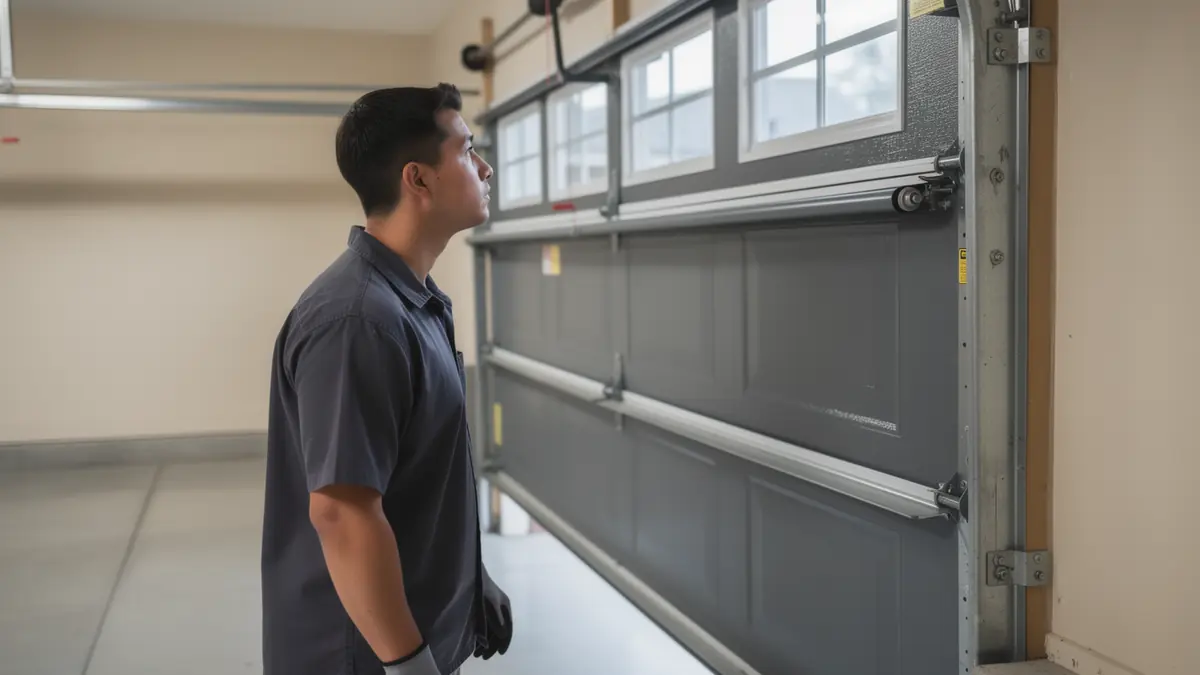
Start with the rollers. On houses from the 1960s-70s wave that makes up most of this area's housing stock, the original rollers were often steel-on-steel or early nylon, neither of which ages well. A rhythmic clunk as the door travels is almost always a flat spot on a roller, and it gets louder, not quieter, once temperatures drop into the severe-cold range we get here.
Next, check the track brackets where they bolt to the frame. In a house built before 1980, the lumber behind that bracket has had forty-plus years of seasonal humidity swings, and the lag screws loosen. A banging sound right as the door starts or stops usually traces back to that bracket, not the opener.
Last, listen for a high metallic squeal specifically in cold weather that disappears once the garage warms up. That's a lubrication issue on the torsion spring coils, and it's one of the few noises that's actually climate-driven rather than age-driven - it shows up here because of how cold our winters get, and it wouldn't show up the same way somewhere milder.
Leaving It Alone
Not every noise needs a call. A door built in the 1979 median year for this area that's been maintained can squeak for a season and still have years left in it - a little noise on an otherwise functioning door, especially right after a cold snap, often resolves with lubrication and nothing else.
We won't talk you into replacing a door that's making noise but still runs smooth, reverses correctly, and holds its balance. With median household income in this service area around $84,375 and a lot of owner-occupied houses built decades ago, we see plenty of homeowners who'd rather spend on upkeep than a full replacement, and for a door that's mechanically sound, that's the right call. If the noise is new, seasonal, and the door still opens and closes evenly, give it a season before you spend money on it.
The Problem
The noise that does need a call is a grinding or a loud bang right at the top of the lift, especially on a door that's original to a house from the 1960s-70s stock common here. That combination - old torsion hardware, decades of cold-weather cycling, and a sudden bang - points to a spring near failure, and a failing spring under tension is a real injury risk, not a maintenance item.
We work across the Wausau area, including out toward Rothschild, Weston, Mosinee, and Merrill, and the pattern repeats: doors from that same build era, in the same climate, failing the same way. We don't try to extend the life of a spring that's already showing wear - once the coils look rusted or unevenly spaced, replacement is the honest answer, not a tune-up. That's the one thing we won't do: sell a quick fix on hardware that's past the point of one.
Frequently asked questions
Why does my garage door get noisier only in winter?
Steel contracts in cold, which opens small gaps at the rollers and track, and torsion springs lose tension as the steel cools. In a severe-cold climate like Wausau's, that seasonal swing is bigger than in milder regions, so noise that's barely noticeable in summer can turn into a clear clunk or squeal by January.
Is a noisy door always a sign of a bigger problem?
No. A door that's loud but still opens evenly, reverses properly, and holds position when stopped halfway is usually fine with lubrication and a roller check. The noises that matter are sudden bangs at the top of the lift or grinding that gets worse, especially on original hardware from a 1960s-70s build.
My house is from the 1970s - should I expect more noise than a newer house?
Likely yes. A lot of the housing stock in this area dates to that period, and original torsion hardware from then wasn't built to run quietly after five decades of Wisconsin winters. That doesn't mean it needs replacing, but it does mean the parts are closer to the end of their working life than a door installed in the last ten years.
Related garage door services in Wausau
More garage door guides
Book garage door service in Wausau
Call now or request a quote - tell us what the door is doing and where you are.